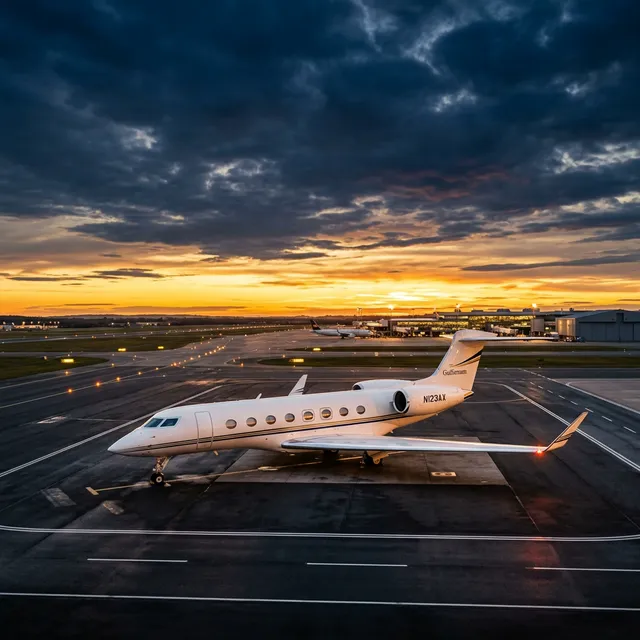
Bombardier Challenger 604 heavy jet on the ramp at dusk with ground lighting reflecting off the fuselage

What a Bombardier Challenger 604 Charter Actually Costs

The Challenger 604 remains one of the most chartered heavy jets in North America. It is not the newest airframe in Bombardier's lineup, but its combination of cabin volume, range, and operator economics keeps it in constant demand.

In This Article

Challenger 604 Hourly Rates: Where the Market Sits Why the 604 Cabin Keeps Winning Charters What Drives the Hourly Rate Sample Challenger 604 Charter Routes Challenger 604 Fleet and Availability Challenger 604 vs. Competing Heavy Jets When Chartering a 604 Stops Making Sense Frequently Asked Questions

Challenger 604 Hourly Rates: Where the Market Sits

A Challenger 604 charters for $4,200 to $5,800 per flight hour, depending on the operator, aircraft age, and interior condition. That puts it squarely in heavy jet territory, competing directly with the Gulfstream GIV-SP and the older Falcon 900. Among the three, the 604 typically commands the highest occupancy rate because operators know it fills seats.

A four-hour flight from Teterboro to San Juan runs $16,800 to $23,200 in flight time. Add FBO handling, international customs fees, positioning, and overnight crew costs, and the all-in invoice typically lands between $22,000 and $30,000 one-way. That is 30-40% less than a Gulfstream G550 covering the same route, with a cabin that seats nearly as many passengers.

$4,200-$5,800
Hourly Rate
4,000 nm
Nonstop Range
488 ktas
High-Speed Cruise

Why the 604 Cabin Keeps Winning Charters

The Challenger 604's cabin is 8.2 feet wide and 6.1 feet tall, giving it a flat-floor, stand-up cross section that wider-body jets in its price range cannot match. Twelve passengers sit comfortably in a standard three-zone configuration: forward club, mid-cabin conference group, and aft divan. The GIV offers similar range but a noticeably narrower cabin at 7.3 feet.

The Three-Zone Layout

Most charter 604s are configured with a four-seat club section forward, a four-seat conference group amidships with a fold-down work table, and a three-seat divan aft that converts to a berthing surface for overnight flights. The aft lavatory is fully enclosed with a solid door, a vanity mirror, and enough room to change clothes. That last detail matters more than it sounds: on a six-hour transatlantic leg, a cramped lavatory curtain is the difference between a productive flight and an endurance test.

For corporate groups of 8 to 10, the Challenger 604 offers something the super-mid category cannot: real workspace. The flat floor and wide aisle let passengers move freely without contorting through a narrow fuselage. Four executives can hold a meeting at the mid-cabin table without lowering their voices because the passenger two rows back can hear every word.

Baggage volume is 115 cubic feet, accessed through an external compartment that does not intrude on cabin space. That is enough for 10 full-size suitcases or a set of golf bags plus carry-ons for a group of eight. The baggage compartment is heated and pressurized, so electronics and wine travel safely.

The Challenger 604 is not the fastest or newest heavy jet on the market. It is the one operators keep because clients keep asking for it.

What Drives the Hourly Rate

The 604 is powered by two General Electric CF34-3B engines, each producing 9,140 pounds of thrust. Combined fuel burn at cruise altitude runs approximately 265 gallons per hour. At $5.75 per gallon, fuel alone costs roughly $1,525 per flight hour. That is the largest single line item on the operator's ledger.

Engine maintenance is the variable that separates a $4,200 quote from a $5,800 quote. Aircraft on comprehensive engine programs like GE OnPoint have predictable per-hour costs. Operators running engines off-program must reserve more aggressively for hot section inspections and overhauls, pushing their rates to the upper end of the range.

Sample Challenger 604 Charter Routes

The following estimates assume a one-way charter from the origin city without repositioning. Actual quotes vary by operator, date, and aircraft availability.

  • New York (TEB) → Los Angeles (VNY): 2,145 nm, 4.8 hrs, $20,200-$27,800. The 604 handles this route nonstop with comfortable fuel reserves.
  • Chicago (MDW) → Palm Beach (PBI): 975 nm, 2.4 hrs, $10,100-$13,900. A Thursday afternoon departure for a long weekend.
  • Miami (OPF) → Cancun (CUN): 590 nm, 1.6 hrs, $6,700-$9,300. International handling adds $800-$1,200 at the destination.
  • Dallas (ADS) → Aspen (ASE): 680 nm, 1.9 hrs, $8,000-$11,000. The 604 handles Aspen's 8,006-foot runway without restriction.
  • Boston (BED) → London Luton (LTN): 3,100 nm, 6.5 hrs, $27,300-$37,700. The 604 can reach London nonstop with favorable winds. Westbound return may require a Gander fuel stop.

Charter a Challenger 604

Our team sources Challenger 604 availability from Part 135 operators across the country.

Request a Quote

Challenger 604 Fleet and Availability

Bombardier delivered 333 Challenger 604s between 1996 and 2007. The type was succeeded by the Challenger 605 and later the 650, but the 604 remains the most widely available Challenger variant on the Part 135 market. Operators that retired older Challenger 601s and 601-3As frequently replaced them with 604s, keeping the type's representation in the charter fleet disproportionately high.

Airframe Longevity and Inspection History

Average age of a charter 604 is now 22 years. That sounds old until you consider the airframe's inspection cycle. The Bombardier heavy maintenance program schedules C-checks at 7,200 flight hours. Most charter 604s have completed two or three C-checks with clean bills of structural health. The aircraft was designed for 30,000 flight hours or 20,000 cycles.

The CF34-3B engines are rated for 8,000 hours between hot section inspections when enrolled in GE's OnPoint program. At typical charter utilization of 600-800 hours per year, an enrolled 604 reaches its first HSI in roughly 10 years. Operators on hourly engine programs avoid the $1.2 million lump-sum overhaul cost, spreading it across every revenue hour instead.

Peak season availability can tighten, particularly during ski season (December through March) and the Northeast-to-Florida migration in November. For guaranteed availability during these windows, booking 5 to 10 days ahead is realistic. Off-peak, same-day positioning from hubs like Fort Lauderdale Executive or Dallas Love Field is common.

Challenger 604 vs. Competing Heavy Jets

The Gulfstream GIV-SP overlaps the 604 in range and price. It cruises slightly faster (476 ktas vs 459 ktas for the 604's normal cruise) but offers a narrower cabin. For passengers who prioritize speed and have six or fewer in the group, the GIV is a reasonable alternative. For eight or more, the 604's cabin width is the deciding factor.

The Challenger 605, which replaced the 604 in 2007, added a Rockwell Collins Pro Line 21 glass cockpit and a redesigned cabin with larger windows. Charter rates for the 605 run $4,800 to $6,400 per hour, a 10-15% premium over the 604 for an aircraft that performs identically in the air. The cabin improvements are genuine but modest.

Stepping up to a Gulfstream G550 at $7,000-$9,500 per hour buys 2,750 additional nautical miles of range and a cabin that is objectively more refined. For domestic missions under 2,500 nm, the G550's premium is difficult to justify. For London, the Bahamas, or Hawaii, the G550's range eliminates fuel stops and schedule risk.

When Chartering a 604 Stops Making Sense

Pre-owned Challenger 604s sell for $3.5 to $6.5 million depending on total airframe time, engine program enrollment, and interior condition. Annual fixed costs for a managed 604 run $650,000 to $900,000 before fuel. That includes two full-time pilots, hangar, insurance, recurrent training, and scheduled maintenance.

At an average charter trip cost of $18,000 (3.5-hour average mission), the crossover point is approximately 250 flight hours per year. Below that threshold, chartering delivers the same aircraft without the depreciation risk. Above it, ownership plus Part 135 charter revenue from third-party flights begins to offset 25-35% of the annual fixed cost.

The 604's entry price is its strongest ownership argument. At $4 million, it is the least expensive way to own a wide-body, transcontinental-capable heavy jet. The charter-versus-own decision for a 604 buyer often comes down to a single question: do you fly 200 hours or 300 hours per year?

Brian Galvan

Written By

Brian Galvan

Founder, The Jet Finder · Private Aviation Operations & Technology

Former Director of Technology at FlyUSA (Inc. 5000 fastest-growing private jet company). Decade of hands-on experience across Part 135 operations, charter sales, fleet management, and aviation data systems.

LinkedInRead Full Profile →
Common Questions

Frequently Asked Questions


8 questions about Challenger 604 charter pricing

That four-hour route costs $22,000 to $30,000 total. The flight time portion runs $16,800-$23,200 at $4,200-$5,800 per hour. On top of that, FBO ramp fees at SJU add $600-$900, international customs processing adds $500-$800, and two-pilot overnight per diem adds $400-$600 if the crew remains at the destination.

The 604 fuselage cross-section is 8.2 feet wide versus the GIV's 7.3 feet. That 10.9-inch advantage creates a flat floor without the step-down found in narrower-body jets. Passengers walk the aisle without ducking or turning sideways. Bombardier inherited the wide-body cross-section from the original Canadair Challenger 600 airframe designed in the late 1970s.

Eastbound, usually not. The 604's 4,000 nm range covers the 3,100 nm BED-to-LTN route with NBAA IFR reserves when jet stream tailwinds are present. Westbound is different: Atlantic headwinds regularly push the required fuel load beyond the 604's maximum, making a Shannon or Gander technical stop standard practice.

GE rates the CF34-3B for 8,000 hours between hot section inspections when enrolled in the OnPoint hourly program. At typical charter utilization of 600-800 flight hours per year, that interval arrives roughly every 10-13 years. Off-program operators face a $1.2 million lump-sum HSI cost, which is why their hourly charter rates sit at the upper end of the $4,200-$5,800 range.

The standard three-zone 604 interior provides two berthing surfaces: the aft divan converts to a flat bed approximately 6 feet long, and the mid-cabin seats can be configured for a second sleeping position. Two passengers sleep comfortably; a third can manage on the forward club seats if reclined. For groups needing four or more sleeping berths, the 604 is not the right aircraft.

The 604 holds a 5,700-foot equivalent cabin altitude at its maximum operating altitude of 41,000 feet. For comparison, older heavy jets like the Hawker 1000 hold 6,800 feet at the same altitude. Lower cabin altitude means higher oxygen saturation for passengers, which reduces fatigue and dehydration on flights longer than four hours.

Passengers will not notice the difference. The 605 replaced the 604's Honeywell Primus 2000 cockpit with Rockwell Collins Pro Line 21 displays, which is exclusively a pilot-facing upgrade. The cabin received slightly larger windows and updated interior materials. Performance is identical: same engines, same range, same speed, same airframe.

Approximately 250 flight hours per year. Pre-owned 604s sell for $3.5-$6.5 million. Annual fixed costs (two pilots, hangar, insurance, training, scheduled maintenance) total $650,000-$900,000 before fuel. At the average charter trip cost of $18,000, a buyer chartering 40 trips per year spends $720,000. Ownership starts saving money above that threshold, especially if the aircraft generates Part 135 charter revenue during downtime.

Continue Reading

Related Articles


Your Next Mission

Ready to Fly?


Whether you need a charter quote or want to explore aircraft options, our team is here.

Contact Us