The Aspen Incident
On December 20, 2025, a Beechcraft Super King Air took off from Aspen with two pilots and no passengers. Somewhere over the Rockies, climbing through 23,000 feet, the aircraft suffered a rapid uncommanded loss of pressurization. The pilots donned their oxygen masks. And then, by their own deliberate decision, they did something no flight crew in the history of aviation had ever done in a real emergency: they handed the airplane to a computer and let it fly them home.
The system they engaged was not a standard autopilot. It was a prototype autonomous flight management system developed under a joint FAA-industry research program. The computer assessed the emergency, calculated the nearest suitable airport, initiated a controlled descent to a safe altitude, and flew a precision approach into Grand Junction. The pilots monitored. They never touched the controls again.
The flight lasted forty-three minutes. It received almost no media coverage. And it may have been the most significant moment in aviation since the Wright Brothers left the ground at Kitty Hawk.
The question is no longer whether machines can fly aircraft safely. The question is how long we continue pretending they cannot.
Autonomy Is Already Here
The conversation about pilotless aircraft tends to be framed as futuristic. It is not. The technology exists today, and it has existed in various forms for decades. What is changing is the willingness to acknowledge it.
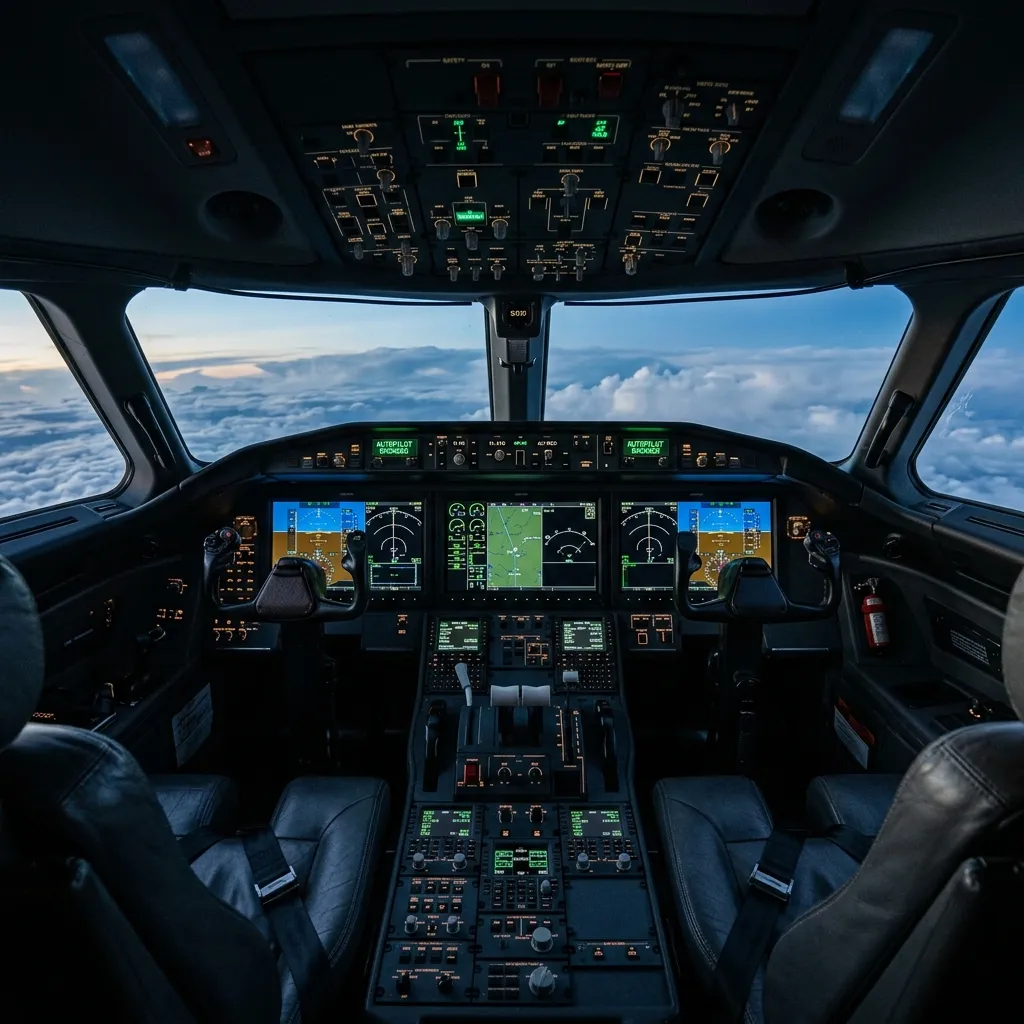
Modern business jets already fly themselves for approximately 95% of every mission. The autopilot engages shortly after takeoff and disengages moments before landing. In many aircraft, the autoland system can execute a full Category III approach and landing in zero visibility, touching down with greater precision than any human pilot.
The Garmin Autoland system, certified since 2020, can detect pilot incapacitation, select an appropriate airport, communicate with air traffic control, fly an approach, land the aircraft, and bring it to a stop on the runway centerline. It does this without any human input whatsoever. It is installed in production aircraft that are flying today.
The military has operated autonomous and remotely piloted aircraft for over two decades. The MQ-9 Reaper has logged millions of flight hours. The X-47B demonstrated autonomous carrier landings in 2013. The Air Force's Skyborg program is building AI wingmen that fly combat missions alongside manned fighters. The technology is mature. The resistance is cultural.
The Gap Between Capability and Permission
What separates a Garmin Autoland from a fully autonomous commercial flight is not engineering. It is regulation, liability frameworks, and public perception. The system already exists that could fly a Cessna Citation from Teterboro to Palm Beach without a pilot touching the controls from engine start to engine shutdown. The reason it does not happen is that we have not yet decided to let it.
This distinction matters. When people argue that autonomous flight is "decades away," they are not making a technical claim. They are making a political and psychological one. And those barriers, unlike engineering barriers, can collapse quickly.
The Regulatory Shift
The FAA has historically been a conservative regulator, and for good reason. Aviation safety records are built on cautious, incremental progress. But the agency is not immune to economic pressure, and the economic pressure is building.
In March 2026, the FAA issued Advisory Circular 23.1309-2A, which for the first time established a formal framework for certifying "reduced crew operations" in Part 23 aircraft. The circular does not authorize pilotless flight. But it creates the regulatory architecture for single-pilot operations augmented by autonomous systems, a stepping stone that did not exist eighteen months ago.
Europe is moving faster. EASA published its Artificial Intelligence Roadmap 2.0 in late 2025, explicitly targeting "increased automation in the cockpit" as a near-term objective. The agency has funded three separate research programs exploring single-pilot operations for commercial transport aircraft, with preliminary certification guidance expected by 2028.
China's CAAC has taken the most aggressive position. The agency certified the EHang 216-S autonomous air taxi for commercial passenger operations in 2024, making China the first country to approve fully autonomous passenger-carrying aircraft. The vehicle is small, the range is limited, and the operating environment is constrained. But the precedent is set.
Insurance and Economics
The insurance industry will be the silent accelerant. Underwriters are, by nature, indifferent to tradition. They care about risk data. And the risk data increasingly favors machines over humans.
Approximately 80% of aviation accidents are attributed to human factors: spatial disorientation, controlled flight into terrain, loss of situational awareness, fatigue, impairment, distraction. Autonomous systems do not get tired. They do not get distracted. They do not fly into mountains because they misread an altimeter.
As the actuarial data matures, and as autonomous systems accumulate flight hours with superior safety records, insurers will begin pricing policies accordingly. An operator running a certified autonomous system may eventually pay lower premiums than one employing human pilots. When that crossover happens, the economic incentive structure will make the transition irreversible.
When the insurance company charges you less to remove the pilot than to keep one, the philosophical debate ends and the accounting begins.
The Pilot Shortage Accelerant
The global pilot shortage is not a temporary market imbalance. It is a structural demographic crisis. The major U.S. airlines will need to hire over 30,000 pilots in the next five years to replace retirements alone. The training pipeline cannot keep pace. ATP minimums of 1,500 hours create a bottleneck that no amount of funding can quickly resolve.
Business aviation feels this acutely. Corporate flight departments compete with airlines offering higher salaries, better schedules, and more predictable career paths. Charter operators struggle to staff aircraft. The pilot shortage is already constraining growth in charter operations and driving up operating costs across the industry.
Autonomous systems offer the only scalable solution. Not as a replacement for all pilots overnight, but as a force multiplier that allows the industry to maintain and expand operations with fewer crew members. Single-pilot operations, augmented by AI, will likely be the first major shift, effectively doubling the capacity of the existing pilot workforce.
What Changes, What Stays
The transition will not be binary. There will be no single day when pilots disappear from cockpits. Instead, the shift will follow the pattern that autonomous technology always follows: gradual adoption in low-risk environments, expanding to broader applications as trust builds.
Phase 1: Cargo and Repositioning (2026-2030)
Unmanned cargo operations and aircraft repositioning flights will be the first commercial applications. No passengers means lower regulatory barriers. FedEx and UPS have both invested heavily in autonomous cargo aircraft programs. Reliable Robotics and Xwing have demonstrated fully autonomous flights of Cessna Caravans, the workhorse of the cargo feeder network.
Phase 2: Single-Pilot Operations (2028-2033)
Regulatory frameworks for single-pilot operations in business aircraft will emerge by the late 2020s. The remaining pilot becomes a systems manager and decision-maker, with the autonomous system handling all routine flight operations. This mirrors the historical transition from three-person to two-person cockpits in the 1980s, which faced identical resistance and identical outcomes.
Phase 3: Optional Pilot (2032-2038)
As autonomous systems accumulate hundreds of thousands of flight hours with demonstrated safety records superior to human-piloted operations, regulations will begin to allow pilotless operations in specific categories. Business aviation, with its controlled environments and sophisticated clientele, may move faster than the airlines.
Phase 4: Autonomous Default (2035+)
By the late 2030s, the presence of a human pilot will be optional for most Part 91 and Part 135 operations. Some operators and passengers will choose to retain pilots, much as some people prefer manual-transmission cars. But the default will shift. The aircraft will fly itself. The human will be a passenger.
The Timeline
Predictions are easy to mock and difficult to make. But the trajectory is clear, and the convergence of technology, regulation, economics, and demographics points in one direction.
The 2030s will be the transition decade. Not because the technology is not ready sooner, but because the regulatory and cultural adaptation requires time. By 2040, pilotless business jet flights will be routine. By 2045, a human pilot in a cockpit will be as noteworthy as a human elevator operator is today.
This is not a comfortable prediction for an industry built on the mystique of the pilot. But comfort has never been a prerequisite for accuracy. The data is clear. The economics are clear. The technology is clear. The only remaining variable is how long we choose to look away.
The quiet revolution is already underway. The cockpit just does not know it yet.