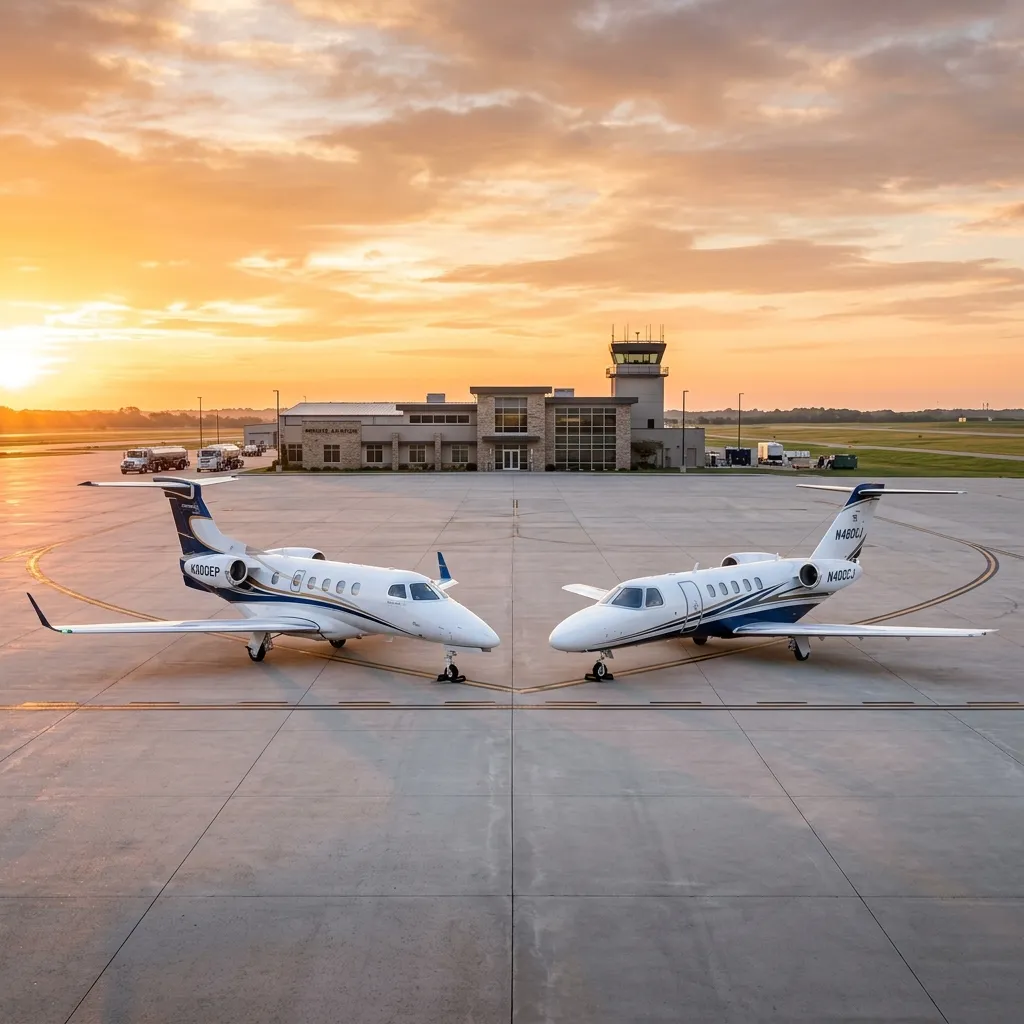
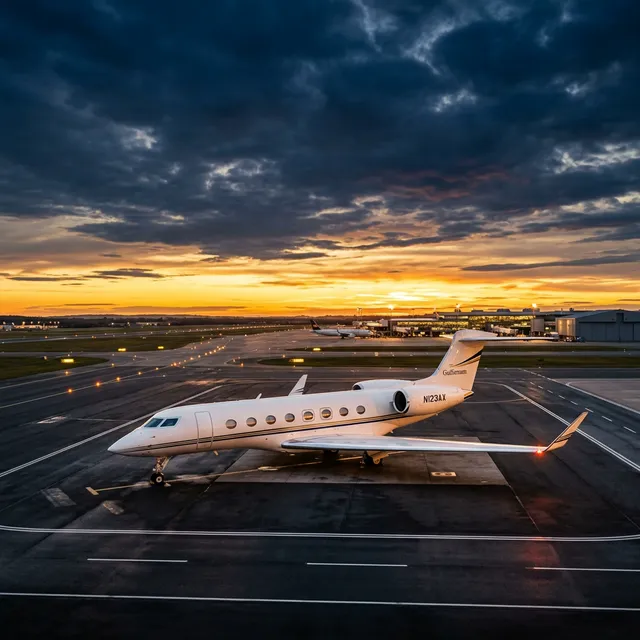
What Defines a Light Jet?
The light jet category bridges the gap between turboprops and midsize jets. By FAA definition, a light jet has a maximum takeoff weight (MTOW) of less than 12,500 pounds, though modern "super-light" jets like the Phenom 300 routinely push this boundary (18,078 lbs) while maintaining light-jet operating economics.
Light jets are optimized for missions under three hours. They fly just as high as heavy jets (typically up to 45,000 feet, allowing them to cruise above commercial traffic and weather) and cruise at comparable speeds (400 to 450 knots). The tradeoff is cabin volume and range. You cannot stand up in a light jet, and coast-to-coast flights require a fuel stop.
Their primary advantage is runway performance. A light jet can operate out of 4,000-foot runways that heavier aircraft cannot access, opening up thousands of smaller regional and municipal airports. This proximity to your actual destination often makes a light jet faster door-to-door than a larger, faster aircraft that must use a major airport.
A light jet provides 90% of the speed and altitude capability of a midsize jet at roughly 65% of the hourly cost.
The Embraer Phenom 300: The Category Leader
The Embraer Phenom 300 (and its updated variants, the 300E) is the best-selling light jet in the world for a reason. It redefined the category by offering midsize performance at light jet operating costs.
Capabilities and Performance
- Max Range: 2,010 nautical miles (with IFR reserves)
- High-Speed Cruise: 464 knots (Mach 0.80)
- Cabin: The widest in its class, featuring Embraer's "Oval Lite" cross-section.
- Baggage: 84 cubic feet (massive for a light jet, capable of holding skis and golf clubs).
The Phenom 300 is ideal for 6-7 passengers. It is one of the few light jets that can comfortably seat 8 if the belted lavatory is utilized. Its range allows for non-stop flights from New York to Miami, or Los Angeles to Cabo San Lucas, with substantial fuel reserves. Embraer achieved this by optimizing the airframe drag and outfitting it with Pratt & Whitney Canada PW535E engines.
The Cessna Citation CJ Series: The Proven Standard
Cessna's Citation Jet (CJ) family—specifically the CJ3 and CJ4—represents the historical backbone of the light jet charter market. While the Phenom 300 offers sheer volume, the CJ series offers unparalleled reliability, short-field capability, and a massive network of trained pilots and maintenance facilities.
Citation CJ3/CJ3+
The CJ3 is the workhorse of the fleet. It typically seats 6 passengers in a center-club configuration. With a range of 1,850 nautical miles and a cruise speed of 416 knots, it is slower than the Phenom 300 but excels in runway performance and operational efficiency. It is the perfect aircraft for a 2-hour regional flight such as Chicago to Teterboro.
Citation CJ4/CJ4 Gen2
The CJ4 is Cessna's answer to the super-light category. It features a swept wing (unlike the straight wing on the CJ3), increasing its cruise speed to 451 knots and pushing its range to 1,926 nautical miles. It offers a slightly longer cabin than the CJ3, accommodating up to 8 passengers, and features an internally serviceable lavatory.
1,500 - 2,000 nm
Average Light Jet Range
6 - 8
Typical Passenger Capacity
$3,500 - $4,800
Average Hourly Charter Rate
Request a Light Jet Charter
Whether you need a Citation CJ3 for a short hop or a Phenom 300 for maximum range, we provide exact availability and pricing.
Get a Quote →Other Notable Light Jets
Hawker 400XP / Beechjet 400A
A staple of the charter market, the Hawker 400XP (formerly the Beechjet 400A) features a squared-oval cabin design that feels remarkably spacious for its footprint. It lacks the range of the Phenom 300 or CJ4—maxing out around 1,300 nautical miles—but its flat floor and robust construction make it a favorite for short, heavy-load missions like New York to Chicago.
Learjet 70/75
Bombardier's final iterations of the iconic Learjet line, the 70 and 75, offer the highest speeds in the light jet category (Mach 0.81). They feature midsize-jet wing loading, providing an exceptionally smooth ride in turbulence. While production has ceased, they remain highly sought after on the charter market for their speed and aggressive styling.
Pilatus PC-24
Marketed as the "Super Versatile Jet," the PC-24 is a twin-engine jet designed to operate from unpaved and grass strips—a capability utterly unique in this class. It features a massive rear cargo door and a flat floor, making it ideal for passengers carrying oversized gear or those flying into remote mountain airports.
Operational Considerations for Light Jets
When chartering or purchasing a light jet, operational limitations must be factored into the decision. Passengers accustomed to heavy jets are often caught off guard by the baggage and payload restrictions inherent to the light category.
The Payload-Range Tradeoff
You can fill the seats, or you can fill the fuel tanks, but rarely can you do both. If a light jet claims a maximum range of 2,000 nautical miles, that figure usually assumes four passengers and no wind. If you board seven adults with heavy luggage, the maximum fuel load must be reduced to stay under the Maximum Takeoff Weight (MTOW). This significantly shrinks the effective range, turning a non-stop flight into a one-stop flight. Furthermore, flying in the summer months can exacerbate this issue. High temperatures and high-elevation airports decrease air density, meaning the aircraft requires a longer takeoff roll and may need to depart with an even lighter fuel load to safely clear surrounding terrain.
Baggage Reality
Aside from the Phenom 300 and the Pilatus PC-24, luggage space in light jets is highly constrained. Soft-sided duffel bags are preferred over hard-shell roller bags, as pilots must often play Tetris in the external compartments. If the external baggage is full, items cannot simply be piled in the cabin due to FAA egress regulations.
Charter Costs and Economics
Light jet charter rates typically range from $3,500 to $4,800 per flight hour, depending on the specific model, age of the aircraft, and regional availability. This makes them significantly more economical than midsize jets, which generally start at $5,500 per hour.
- Entry-Level Light (e.g., Citation M2): $3,000 - $3,500 / hr
- Standard Light (e.g., Citation CJ3, Hawker 400XP): $3,500 - $4,200 / hr
- Super-Light (e.g., Phenom 300, Citation CJ4): $4,200 - $4,800 / hr
It is important to remember that hourly rate is only part of the equation. A faster super-light jet like a CJ4 may bill at a higher hourly rate than a CJ3, but because it completes the route faster, the total block time—and thus the final invoice—may be nearly identical.
Positioning costs also heavily influence the final quote. A less expensive aircraft that must reposition for two hours to reach you will cost more overall than a more expensive aircraft sitting on your home ramp.
Note: When comparing quotes, always look at the total estimated flight time and the routing. A light jet flying coast-to-coast will require a fuel stop, adding 45-60 minutes to the total travel time and incurring additional cycle costs and FBO fees.