What Part 135 Actually Means
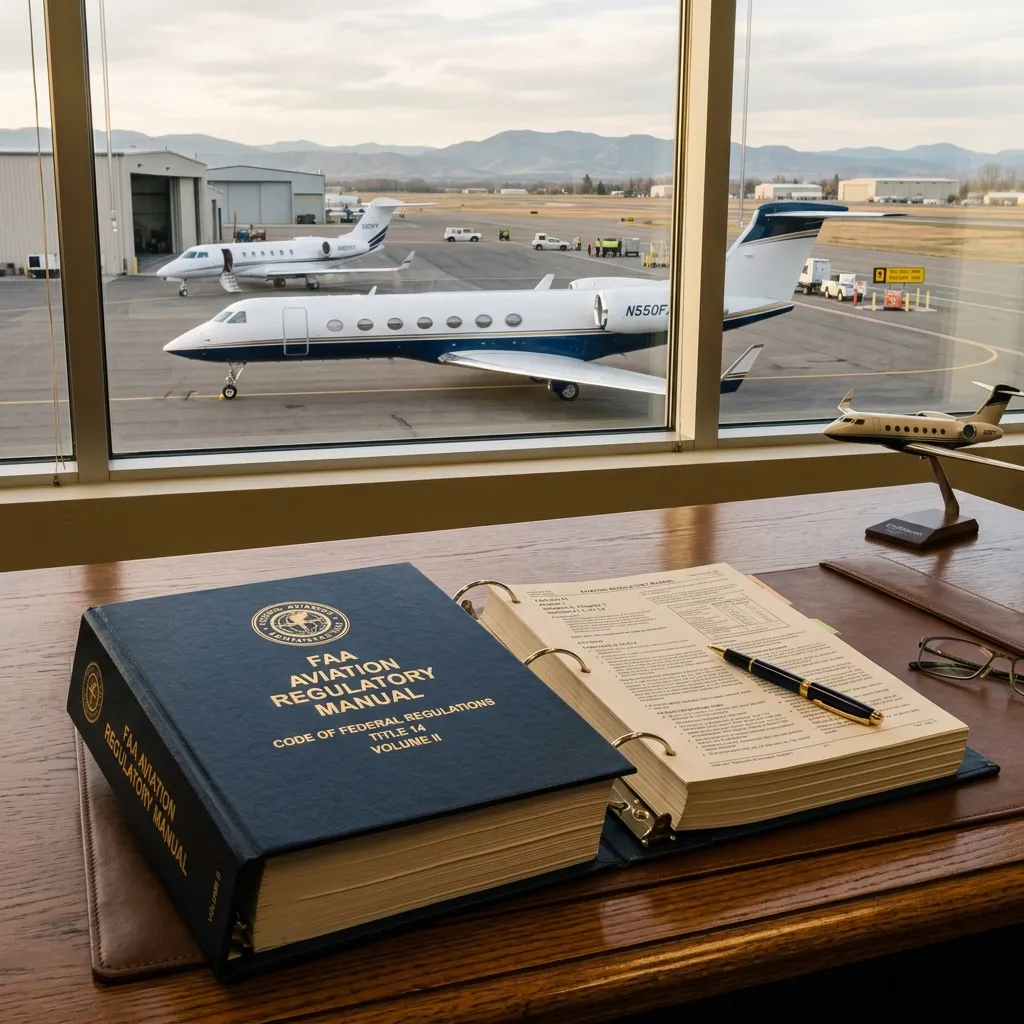
Title 14 of the Code of Federal Regulations, Part 135, governs on-demand air carrier and commuter operations in the United States. Any operator that sells charter flights to the public, whether carrying 1 passenger or 30, must hold a valid Part 135 certificate issued by the FAA. The certificate is specific to the operator, not the aircraft.
Part 135 exists to separate commercial aviation from private aviation. When you fly on your own aircraft for personal or business purposes, you operate under Part 91, which imposes minimal regulatory oversight. The moment you sell a seat or an aircraft to a paying customer, the regulatory framework shifts entirely. Part 135 requires higher crew training standards, stricter maintenance intervals, drug and alcohol testing programs, operations manuals, and FAA-approved dispatch procedures.
The distinction matters because it directly affects your safety as a charter client. A Part 135 operator is subject to unannounced FAA inspections, mandatory incident reporting, and crew rest requirements that Part 91 operators are not. When someone offers you a charter on an aircraft that is not operating under Part 135, you are flying on an unregulated flight. The FAA calls this an illegal charter, and it carries real consequences.
Part 135 is not a quality badge. It is a regulatory floor. The best operators far exceed its requirements. But any operator flying charter without one is operating outside the law.
How an Operator Gets a Part 135 Certificate
Obtaining a Part 135 certificate from the FAA takes 18 to 24 months on average. The process involves five phases defined by the FAA's Order 8900.1: pre-application, formal application, document compliance, demonstration and inspection, and certification. Each phase requires the operator to prove it has the personnel, manuals, training programs, and financial resources to conduct commercial operations safely.
The operator must appoint four key management positions: Director of Operations, Chief Pilot, Director of Maintenance, and Chief Inspector. Each position requires specific aeronautical experience. The Director of Operations must hold an Airline Transport Pilot (ATP) certificate. The Director of Maintenance must hold an FAA mechanic certificate with airframe and powerplant ratings. These are not administrative titles. The FAA holds these individuals personally accountable for regulatory compliance.
The operator must also submit an Operations Specifications document (OpSpecs) that defines exactly what the certificate authorizes: aircraft types, operational areas, kinds of operations (VFR, IFR, day, night), and any special authorizations such as Category II/III instrument approaches or Extended Twin Operations (ETOPS). OpSpecs are not boilerplate. They are tailored to each operator's specific capabilities.
Before the FAA issues the certificate, the operator must complete a series of proving flights. These flights are conducted with an FAA inspector on board, evaluating crew performance, dispatch procedures, maintenance documentation, and compliance with the operations manual. Failure during proving flights restarts the evaluation process.
Part 135 vs Part 91: The Regulatory Gap
Part 91 governs private, non-commercial flight operations. Under Part 91, the pilot-in-command is the final authority on every decision. There are no crew duty time limits (except for specific operations like fractional under Part 91K). There are no mandatory drug testing programs. Maintenance requirements are less prescriptive. The philosophy is that the aircraft owner is assuming the risk for themselves.
Part 135 exists because that assumption breaks down when a paying passenger boards the aircraft. The passenger has no ability to evaluate the crew's fatigue level, the maintenance history of the aircraft, or whether the dispatch decision was operationally sound. Part 135 regulation serves as the passenger's proxy for due diligence.
Key Regulatory Differences
- Crew rest: Part 135 mandates minimum rest periods (10 consecutive hours with opportunity for 8 hours of uninterrupted sleep). Part 91 has no crew rest requirements.
- Duty time: Part 135 limits flight time to 8 hours in any 24-hour period for two-pilot crews. Part 91 has no duty time limits.
- Drug and alcohol testing: Part 135 requires pre-employment, random, post-accident, and reasonable-suspicion testing under DOT protocols. Part 91 does not require testing.
- Maintenance: Part 135 requires an approved maintenance program with specific inspection intervals. Part 91 requires only annual and 100-hour inspections.
- Weather minimums: Part 135 IFR weather minimums are higher than Part 91 at most airports, requiring greater ceiling and visibility margins.