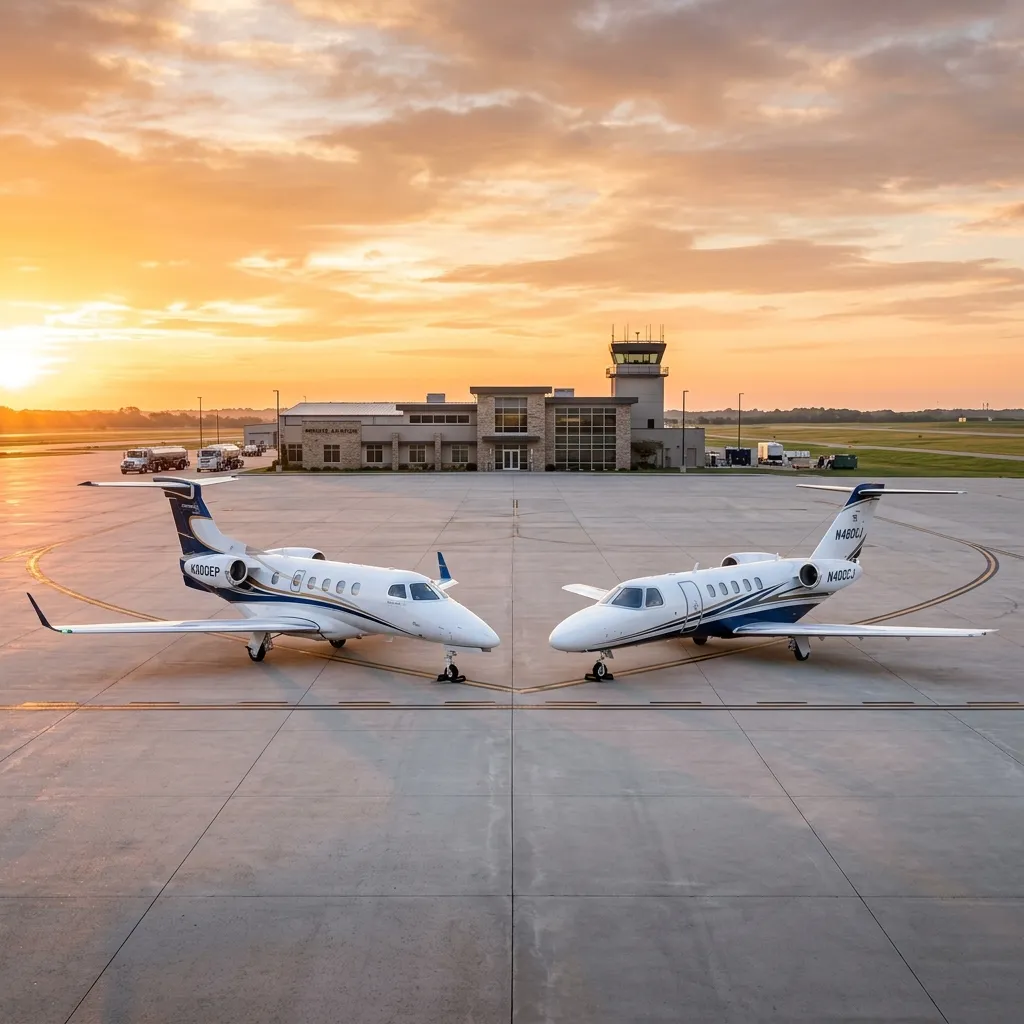
Beechjet 400A light jet on FBO ramp at sunset

Beechjet 400A Charter Cost: What You'll Pay for the Entry-Level Jet

The Beechjet 400A occupies a narrow but persistent niche in the charter market. Built between 1990 and 2003, it offers twin-engine jet performance at hourly rates that undercut nearly every other jet in the fleet.

In This Article

Hourly Rate Breakdown for the Beechjet 400A What Drives Beechjet 400A Charter Pricing The Beechjet 400A Cabin: What Passengers Get Performance Profile: Where the 400A Delivers Beechjet 400A vs Competing Light Jets When the Beechjet 400A Makes Sense to Charter Fleet Status: How Many Beechjet 400As Are Still Flying Frequently Asked Questions

Hourly Rate Breakdown for the Beechjet 400A

Charter operators quote the Beechjet 400A between $2,800 and $3,600 per flight hour, placing it at the bottom of the light jet pricing tier. That rate covers fuel burn of approximately 170 gallons per hour at cruise, crew costs for the two-pilot cockpit, and basic operational overhead. Some older airframes with dated interiors fall below $2,800 on repositioning legs, while freshly refurbished examples with modern avionics push past $3,500.

The 400A's hourly rate sits roughly 15-20% below the Phenom 300 and 10-15% below the Citation CJ3. That discount reflects the aircraft's age and cabin dimensions rather than any performance deficiency. The Pratt & Whitney JT15D-5 engines are proven and relatively economical, burning less fuel per hour than many competitors in the light jet segment.

The Beechjet 400A fleet divides roughly into two tiers. Aircraft with fewer than 6,000 total airframe hours, recently overhauled engines, and refurbished cabins command the top of the rate range. These jets have received six-figure investments in ADS-B Out compliance, Collins Pro Line 21 avionics, and full interior refurbishment. Aircraft with 8,000+ hours, original avionics supplemented by ADS-B transponders, and worn interiors sit at the lower end. Both tiers deliver the same performance envelope; the difference is passenger experience and crew workload.

What Drives Beechjet 400A Charter Pricing

Aircraft Age and Interior Condition

Every Beechjet 400A in the charter fleet was manufactured between 1990 and 2003. The youngest airframes are now over 20 years old. Interior condition varies dramatically. Some operators have invested $300,000 or more in cabin refurbishment with new leather, LED lighting, and updated galley equipment. Others fly the original interior with wear showing on seat bolsters and headliner material. That spread in cabin quality accounts for much of the hourly rate variance.

Positioning and Repositioning Costs

Because the 400A fleet is smaller and geographically concentrated, positioning flights can add 30-60 minutes of flight time to your trip cost. If the nearest available Beechjet is based 200 nm from your departure airport, you are effectively paying for that ferry leg. Operators sometimes absorb partial positioning costs to fill gaps in their schedule, but the traveler should budget for at least one positioning leg per trip.

Peak Season and Event Surcharges

During high-demand periods like Thanksgiving, Christmas, the Super Bowl, and major golf tournaments, expect 20-35% premium pricing. The 400A is less affected by peak surcharges than larger jets because demand for entry-level light jets tends to be more price-sensitive and less tied to corporate travel calendars.

The Beechjet 400A Cabin: What Passengers Get

The cabin measures 15.5 feet long, 4.8 feet wide, and 4.8 feet tall. That width is noticeably narrower than the Citation CJ3 (4.8 ft) and substantially tighter than the Phenom 300 (5.1 ft). Seven passengers fit in a standard club-four plus three configuration, but realistically, four passengers travel in comfort. With luggage for a weekend trip, five passengers is the practical limit.

The baggage compartment holds 53 cubic feet of luggage, accessible through an external door. That capacity handles golf bags, ski equipment, or standard business luggage for four travelers without issue. The cabin does not have a fully enclosed lavatory; a curtained emergency facility is standard. For flights under two hours, this is acceptable. For longer trips, passengers should plan accordingly.

The Beechjet 400A was designed when 'light jet' meant something different. The cabin is functional, not luxurious. Passengers who expect Phenom 300-level refinement will notice the difference immediately. Those who want jet speed at turboprop pricing will find the trade-off acceptable.

The 400A cabin is a product of its Mitsubishi Diamond heritage. The fuselage cross-section was designed in the late 1970s when business jets carried three or four executives on two-hour domestic hops. It was not designed for the expectations of 2026 charter passengers who may have experienced a Phenom 300 or Citation CJ4 cabin. Operators who maintain the 400A fleet invest in new upholstery, carpet, and LED lighting to bridge the gap between the original 1990s interior and current passenger expectations.

Performance Profile: Where the 400A Delivers

Maximum range of 1,500 nm covers most domestic routes with reserves. New York to Miami, Chicago to Denver, Los Angeles to Seattle: all within the 400A's reach on a single fuel stop. The aircraft cruises at 460 kts (529 mph) at FL 410, with a maximum operating altitude of 45,000 feet. That altitude capability keeps it above most weather and commercial traffic, delivering smooth rides on routes where turboprops struggle.

$2,800-$3,600
Hourly Rate Range
1,500 nm
Maximum Range
7-8
Passenger Capacity
539 mph
Maximum Speed

Takeoff distance of 3,580 feet at sea level gives the 400A access to most business airports in the continental United States. It handles well at altitude airports like Aspen (ASE) and Telluride (TEX) within weight restrictions, though payload may be reduced on hot days at high-elevation fields. The aircraft's short-field performance is competent but not exceptional compared to purpose-built short-field designs like the Pilatus PC-24.

The JT15D-5 engines are among the most mature turbofan powerplants in business aviation. More than 5,000 units have been produced across all variants. Parts availability is excellent, and overhaul shops throughout the U.S. and Europe compete for JT15D work, keeping maintenance costs lower than engines with smaller installed bases. This parts ecosystem is a key reason operators continue to fly the 400A profitably at hourly rates that would not sustain aircraft with rarer engine types.

Charter a Beechjet 400A

We source Beechjet 400A availability from Part 135 operators across the U.S.

Request a Quote

Beechjet 400A vs Competing Light Jets

The 400A competes primarily on price. Against the Citation CJ3 ($3,500-$4,200/hr), the Beechjet saves roughly $700-$800 per flight hour. That difference adds up quickly on multi-leg trips. Against the Phenom 300 ($4,200-$5,200/hr), the savings are even more pronounced, though the Phenom delivers a categorically better cabin experience with its flat floor, larger windows, and modern systems.

For charter clients who need jet speed on a 2-3 hour domestic route and prioritize cost over cabin luxury, the 400A remains a legitimate option. The aircraft has a devoted following among operators who appreciate its low acquisition cost, reasonable maintenance burden, and reliable Pratt & Whitney powerplants.

When the Beechjet 400A Makes Sense to Charter

  • Domestic routes under 1,200 nm where you need jet speed but not a premium cabin
  • Business day trips for 2-4 passengers where cost per hour matters more than legroom
  • Repositioning legs where operators discount the aircraft to fill dead time
  • First-time charter clients testing the waters before committing to a jet card
  • Multi-stop itineraries where cumulative hourly savings offset the narrower cabin

The 400A is not the right choice for transatlantic routing (insufficient range), parties over five passengers (cabin constraints), or clients who expect a contemporary cabin experience. For those missions, step up to a CJ3 or Phenom 300 and accept the higher hourly rate.

Fleet Status: How Many Beechjet 400As Are Still Flying

Approximately 275 Beechjet 400A airframes were delivered between 1990 and 2003. As of early 2026, roughly 180-200 remain active in the FAA registry, with the balance retired, exported, or parked in long-term storage. The active fleet splits between Part 91 owner-operators and Part 135 charter certificate holders, with charter operations accounting for an estimated 40-50% of flight hours.

Fleet attrition has accelerated since 2020 as older airframes face expensive avionics mandates (ADS-B Out compliance) and engine overhaul cycles that exceed the aircraft hull value. A Beechjet 400A with an upcoming double engine overhaul costing ,000 on an airframe worth ,000 faces a difficult economic equation. Operators who have already completed these major inspections hold aircraft that will fly productively for another decade.

Brian Galvan

Written By

Brian Galvan

Founder, The Jet Finder · Private Aviation Operations & Technology

Former Director of Technology at FlyUSA (Inc. 5000 fastest-growing private jet company). Decade of hands-on experience across Part 135 operations, charter sales, fleet management, and aviation data systems.

LinkedInRead Full Profile →
Common Questions

Frequently Asked Questions


6 questions about Beechjet 400A charter costs

The Beechjet 400A uses two Pratt & Whitney JT15D-5 engines, each producing 2,900 pounds of thrust. The hot section inspection interval is approximately 3,500 hours, with a full overhaul at 5,500-6,000 hours. Engine maintenance reserves typically run - per engine per flight hour through hourly cost programs.

The Beechjet 400A traces directly to the Mitsubishi MU-300 Diamond I, which Beech Aircraft acquired rights to in 1985. Beech upgraded the engines from JT15D-4 to JT15D-5, redesigned the wing leading edge, added winglets on later models, and modernized the cockpit. The fuselage cross-section remained unchanged, which is why the 400A cabin feels tighter than jets designed from scratch in the 1990s and 2000s.

Most charter Beechjet 400As now operate with upgraded Collins Pro Line 21 avionics, replacing the original Pro Line 4 suite. Operators who invested in the avionics upgrade gain ADS-B Out compliance, WAAS LPV approach capability, and integrated electronic charts. Some aircraft still fly with Pro Line 4 avionics supplemented by ADS-B transponders.

Yes. The Beechjet 400A meets Teterboro Stage 3 noise requirements and operates without curfew restrictions at TEB. Its 3,580-foot balanced field length is well within TEB Runway 6/24 at 7,000 feet. The aircraft frequently operates on Northeast corridor routes including TEB to Nantucket, Bedford, and White Plains.

The Beechjet 400A has a 53-cubic-foot external baggage compartment accessed through a door on the left fuselage behind the wing. Unlike the Phenom 300 or Citation CJ4, there is no internal baggage area accessible during flight. All luggage goes in the external compartment before engine start. This arrangement is standard for the era but less convenient than modern designs with cabin-accessible storage.

Beechjet 400A resale values range from ,000 for high-time airframes with older avionics to .5 million for low-time examples with Pro Line 21 upgrades and recent engine overhauls. Values have stabilized after a decade of decline. Aircraft that have completed the ADS-B Out mandate and passed their latest engine hot sections hold value better than those approaching major inspections. The floor appears to be set by the scrap and parts value of the engines, which alone carry ,000-,000 in core exchange value.

Continue Reading

Related Articles


Your Next Mission

Ready to Fly?


Whether you need a charter quote or want to explore aircraft options, our team is here.

Contact Us