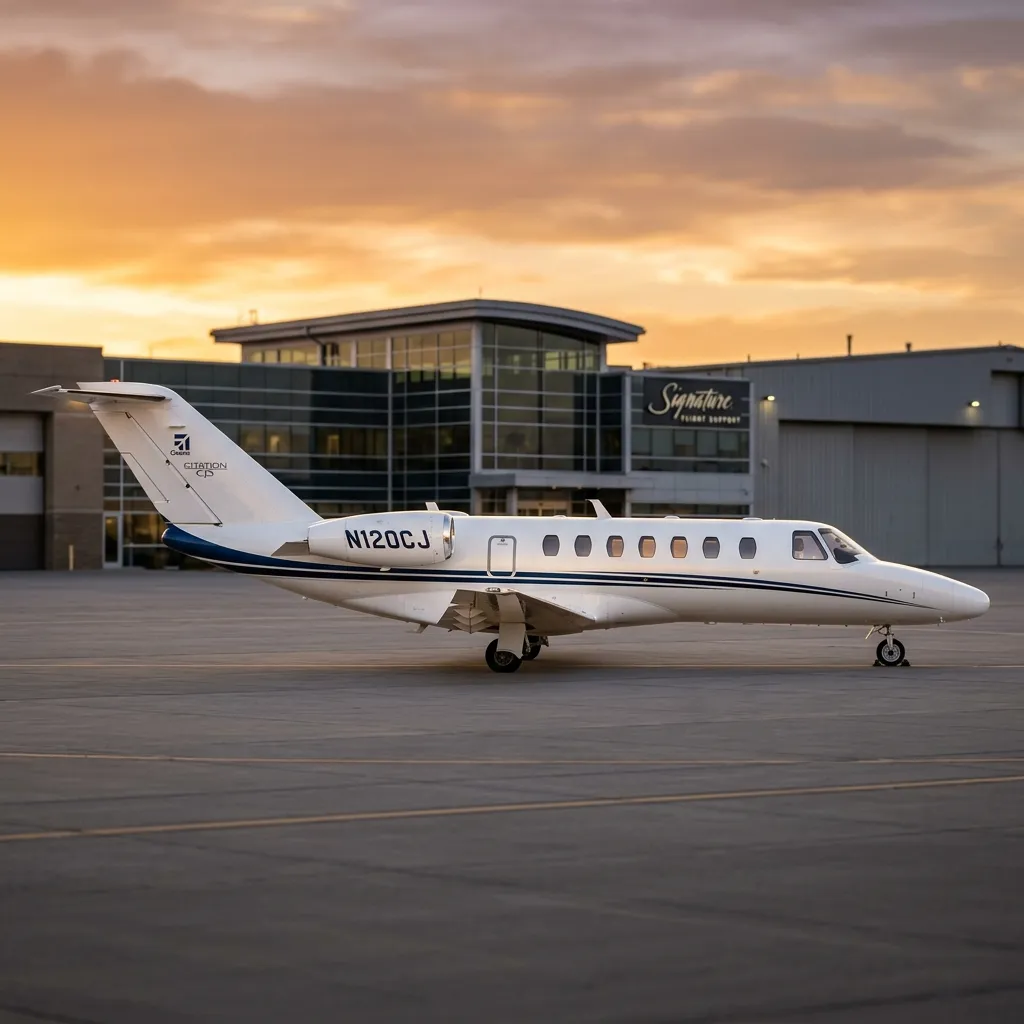
Built for the Left Seat
Between 2004 and 2014, Cessna delivered 410 Citation CJ3 airframes. The majority went to owner-operators, not charter fleets or corporate flight departments. That ratio tells you everything about who this aircraft was designed for. The CJ3 is a single-pilot-certified light jet that prioritizes simplicity and accessibility over features that only matter to passengers who never touch the yoke.
The cockpit layout reflects this. Rockwell Collins Pro Line 21 avionics present a clean, logical scan pattern across three large-format displays. The overhead panel is uncluttered. Systems integration is intuitive enough that transitioning from a King Air or a piston twin requires minimal adjustment, which is precisely why so many piston-to-jet upgrade buyers land on the CJ3 as their first turbine aircraft.
The CJ3 is the jet you buy when you want to fly it yourself. The systems are designed for a single pilot to manage alone at FL450 without a second pair of hands. That is not a limitation. It is the entire point.
Insurance underwriters recognized this early. CJ3 hull and liability policies remain among the most competitively priced in the light jet category for owner-pilots with 500+ total hours and a completed initial type rating. The combination of Cessna's safety record, single-pilot certification, and a well-documented training pipeline through FlightSafety International keeps annual premiums between $18,000 and $28,000 for most profiles.
Williams FJ44-3A: Maintenance and Fuel Burn
Two Williams International FJ44-3A turbofans produce 2,780 pounds of thrust each. The FJ44 series has a well-earned reputation for low maintenance burden. Time between overhaul (TBO) sits at 5,000 hours, which for a typical owner flying 200 to 300 hours per year translates to roughly 17 to 25 years before the first scheduled hot section.
Direct Operating Cost Breakdown
Williams offers the TAP (Total Assurance Program) Blue engine maintenance plan, which spreads overhaul costs across flight hours at a fixed rate. Most CJ3 owners enrolled on TAP report total variable operating costs between $1,500 and $1,700 per flight hour, making it one of the lowest cost-per-mile jets in the FAA registry.
Fuel burn at normal cruise (380 knots, FL430) averages 145 gallons per hour. That is 30 gallons less than a Phenom 300 and 20 gallons less than a CJ4. For an owner flying 250 hours annually, the fuel savings alone can exceed $48,000 per year compared to the next step up in the CJ lineup.
The Cabin: Honest Assessment
The CJ3 cabin measures 15.7 feet long, 4.8 feet wide, and 4.8 feet tall. In a light jet, those are respectable numbers. In isolation, they sound adequate. In practice, the cabin is tight for anyone over six feet tall. Standing fully upright is not possible for most adults.
Standard configuration seats six passengers in a club arrangement with a single forward-facing seat aft. The seventh seat exists on paper, but loading seven adults with luggage for a three-hour flight requires honest conversations about weight and balance. Realistically, the CJ3 is a four-passenger jet that tolerates six on shorter legs.
The belted lavatory is enclosed by a curtain, not a door. For flights under two hours, passengers generally do not notice. On a four-hour coast-to-coast positioning, the lack of a proper lavatory door becomes a cabin comfort issue, particularly with a full manifest.
Where the Cabin Wins
Baggage capacity. The CJ3 offers 66 cubic feet of externally accessed luggage space, which is more than competitive with the Phenom 300's 72 cubic feet and significantly more usable than the HondaJet's divided compartment. For an owner loading golf clubs, hunting gear, or ski equipment, the CJ3 accommodates without compromise. And the baggage door is accessible on the ground without special equipment.
Looking for a CJ3 Charter or Acquisition?
Our team sources CJ3 availability from vetted Part 135 operators and connects buyers with qualified sellers.
Contact Us →Where the CJ3 Excels (and Where It Doesn't)
The aircraft's 2,040 nautical mile range positions it for coast-to-coast domestic flights with one stop, or nonstop legs of up to 4.5 hours duration. It is not a transcontinental nonstop machine. The Phenom 300 and CJ4 both outrange it by 100 to 200 nm. But for the regional and cross-country missions that constitute 85% of owner-pilot flying, the CJ3 covers every city pair in the lower 48 with a single fuel stop at most.
- Dallas (ADS) to Teterboro (TEB): 1,320 nm, approximately 3.5 hours nonstop. A core executive corridor flown comfortably within range.
- Scottsdale (SDL) to Aspen (ASE): 340 nm, roughly 1.2 hours. Short-field performance handles ASE's 7,820-foot elevation and 8,006-foot runway with appropriate margins.
- Atlanta (PDK) to Palm Beach (PBI): 530 nm, about 1.5 hours. The prototypical weekend getaway mission this jet was designed around.
- Van Nuys (VNY) to Cabo San Lucas (SJD): 870 nm, roughly 2.5 hours. International capability with straightforward customs clearance on return.
Where the CJ3 struggles: high-density altitude airports in summer with a full cabin and fuel. Aspen in July with six passengers and bags requires careful weight analysis. The FJ44-3A engines feel their limitations above 8,000 feet MSL in hot conditions, and takeoff performance degrades noticeably. This is not unique to the CJ3, but the 2,780-pound thrust rating provides less margin than the Phenom 300's 3,360-pound PW535E.
CJ3 vs CJ3+: What Changed
Cessna introduced the CJ3+ in 2014 with one headline upgrade: Garmin G3000 avionics replaced the Rockwell Collins Pro Line 21. The rest of the airframe remained essentially unchanged. Same engines. Same fuselage. Same flight characteristics. The avionics swap, however, transformed the cockpit experience entirely.
The G3000 touchscreen interface is more intuitive for pilots transitioning from Garmin-equipped piston aircraft. Synthetic vision, graphical flight planning, and wireless database updates eliminated the most common complaints about the older Pro Line 21 system. For a buyer choosing between a late-model CJ3 and an early CJ3+, the avionics difference alone justifies the $500,000 to $800,000 price gap in the used market.
However, the Pro Line 21 in the original CJ3 remains a fully capable IFR platform. Owners who completed initial training on the Collins system often prefer its button-and-knob interface over Garmin's touchscreen logic. The CJ3 is not obsolete. It is simply a generation behind in cockpit technology, which, for a jet priced at $3.5 to $4.5 million on the used market versus $5.5 to $6.5 million for a CJ3+, represents a meaningful value proposition.
The Pre-Owned Market in 2026
As of Q1 2026, approximately 35 to 45 CJ3 airframes are listed for sale at any given time, representing roughly 9% of the total fleet. Average asking prices for mid-time examples (2,500 to 4,000 total hours) range between $3.8 million and $4.8 million. Low-time, late-serial-number aircraft (2012 to 2014 production) with fresh inspections command premiums up to $5.5 million.
The CJ3 holds its value better than most light jets in this age bracket. Cessna's brand recognition, the Williams engine's long TBO, and single-pilot certification create a deep and stable buyer pool. Average time on market runs 90 to 120 days for properly priced airframes. Overpriced listings sit for six months or more.
Pre-buy inspection is straightforward. The CJ3 airframe has no fleet-wide Airworthiness Directives that create surprise costs. Buyers should focus on engine time remaining to next hot section, avionics condition (particularly WAAS/LPV approach capability), and interior refurbishment quality. The most common post-purchase expense is an interior refresh, which runs $150,000 to $250,000 depending on scope.