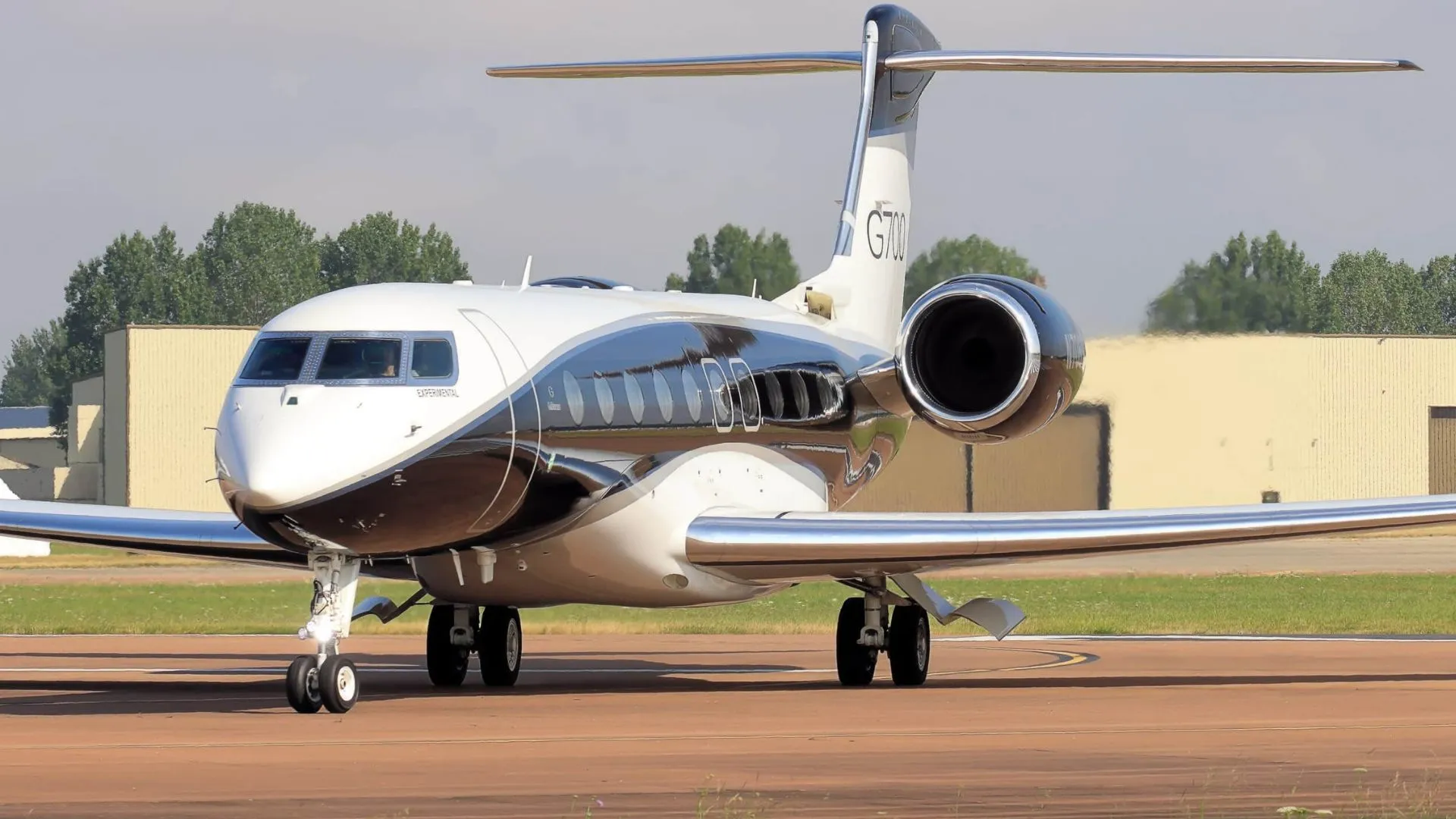
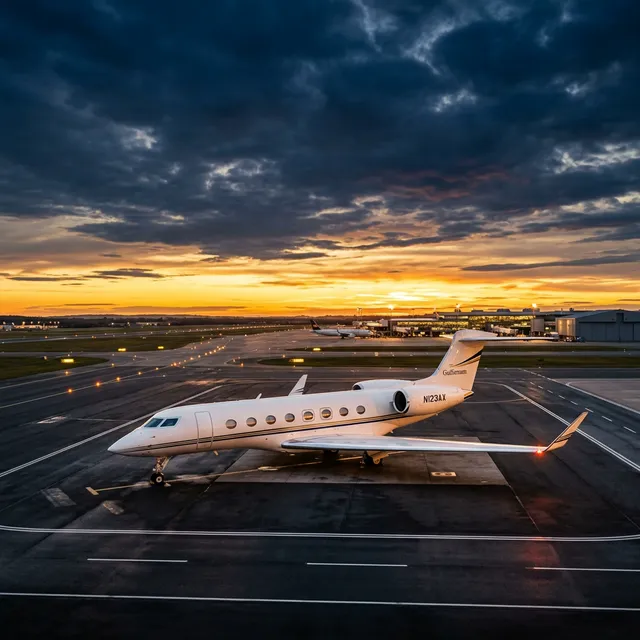
Gulfstream G650 private jet on a tarmac at golden hour with its cabin door open

The Gulfstream G650

Between 2012 and 2025, Gulfstream delivered over 550 G650 and G650ER aircraft. It became the default answer to a question that most corporate flight departments did not realize they were asking: what does a flagship look like when range stops being a limitation?

In This Article

How the G650 Took Over Performance: The Numbers That Defined a Category The Cabin That Set the Standard Ownership Economics: What a G650 Actually Costs The G650 on the Charter Market The G700 Transition: What It Means for G650 Values Frequently Asked Questions

How the G650 Took Over

When Gulfstream announced the G650 in 2008, the backlog filled within 18 months. Deliveries began in 2012, and by 2014, delivery positions were trading on the secondary market for $5-$8 million above list price. This was not hype. It was a market signaling that it had been underserved.

The aircraft that preceded the G650, the Gulfstream G550, could fly 6,750 nautical miles. The Bombardier Global Express XRS reached 6,150 nm. Both were excellent aircraft. But neither could fly New York to Tokyo nonstop with a full passenger load against winter headwinds. The G650 could. That single capability, nonstop transpacific range with real payload, changed the calculus for every Fortune 500 flight department evaluating their next aircraft.

Gulfstream delivered over 550 G650 and G650ER aircraft before transitioning production to the G700 and G800. The type holds approximately 62% of the active ultra-long-range fleet in corporate service. No other aircraft in business aviation history achieved that level of market capture in its category.

The delivery position premium itself became a market indicator. In 2013 and 2014, brokers facilitated position trades where buyers paid $5 million to $8 million above the $65 million list price simply to move up in the queue. Gulfstream eventually tightened transfer rules, but the secondary market pricing proved that demand had outstripped production capacity by a factor no one at Savannah had modeled.

Performance: The Numbers That Defined a Category

The G650's Rolls-Royce BR725 engines produce 16,900 pounds of thrust each. At long-range cruise of Mach 0.85, the aircraft covers 7,000 nautical miles. The G650ER variant, introduced in 2014, extends that to 7,500 nm through additional fuel capacity without structural changes to the airframe.

SpecificationG650G650ER
Max Range7,000 nm7,500 nm
Max Speed (Mmo)Mach 0.925Mach 0.925
Long-Range CruiseMach 0.85Mach 0.85
Max Passengers1919
Typical Configuration13-16 pax13-16 pax
Cabin Length46.8 ft46.8 ft
Cabin Height6.4 ft6.4 ft
Cabin Width8.5 ft8.5 ft
Ceiling51,000 ft51,000 ft
Takeoff Distance5,858 ft6,299 ft
EngineRolls-Royce BR725 (x2)Rolls-Royce BR725 (x2)
New List Price (2024)$65M (discontinued)$71.5M (discontinued)
Hourly Charter Rate$8,500-$12,000$9,000-$13,000
Baggage Volume195 cu ft195 cu ft

Maximum operating speed is Mach 0.925, making the G650 one of the fastest civil aircraft in production during its run. At high-speed cruise of Mach 0.90, range drops to approximately 5,900 nm for the standard G650 and 6,400 nm for the ER. The speed-range tradeoff is linear and predictable, which pilots appreciate for flight planning.

The aircraft certifies to 51,000 feet, above virtually all commercial traffic and weather. At those altitudes, passengers experience smoother rides and faster ground speeds due to reduced air density. The G650's fly-by-wire flight controls, a first for Gulfstream, provide stability augmentation that pilots describe as unusually precise for an aircraft of this size.

550+
Aircraft Delivered (2012-2025)
7,500 nm
G650ER Maximum Range
Mach 0.925
Maximum Operating Speed

The Cabin That Set the Standard

The G650's cabin measures 46.8 feet long, 8.5 feet wide, and 6.4 feet tall. Those dimensions allow a three-zone configuration: a forward club section with four seats, a mid-cabin conference or dining group, and an aft stateroom with a divan that converts to a flat bed. Most corporate configurations seat 13 to 16 passengers.

Sixteen oval windows on each side, each measuring 28 by 20.5 inches, are the largest in the business jet category. The cabin altitude at 51,000 feet is 4,850 feet, lower than any competitor at the time of introduction. Lower cabin altitude reduces fatigue on long-haul flights, a detail that matters on 14-hour transpacific sectors.

The cabin management system, designed around Gulfstream's proprietary architecture, controls lighting, temperature, entertainment, and window shades from touchscreen panels or personal devices. Air is 100% fresh, not recirculated, with a complete cabin air exchange every two minutes.

The G650 cabin did not just raise the bar. It redefined what corporate aviation passengers expected from a 14-hour flight.

Considering a G650?

Whether you are evaluating a pre-owned G650 or exploring charter options, our advisory team can provide current market data and operator introductions.

Contact Our Team

Ownership Economics: What a G650 Actually Costs

New G650ER deliveries priced at approximately $71.5 million before Gulfstream ended production in favor of the G700. On the pre-owned market, a 2016-2018 vintage G650ER with 2,500-3,500 hours trades between $38 million and $46 million, depending on interior condition, engine program enrollment, and maintenance status.

Annual fixed costs for a managed G650 run between $1.2 million and $1.6 million: two pilots ($400,000-$500,000 combined), insurance ($150,000-$250,000), hangar ($80,000-$120,000), management fees ($120,000-$180,000), training ($60,000-$80,000), and miscellaneous ($100,000+). Variable costs add $4,500 to $6,000 per flight hour in fuel, maintenance reserves, and landing fees.

Total annual cost of ownership for an owner flying 400 hours per year falls between $3.5 million and $4.2 million. At 600 hours, the number approaches $5.5 million. These figures assume enrollment in a Rolls-Royce CorporateCare engine program and a Gulfstream airframe maintenance plan, which smooth the cost of scheduled inspections.

The G650's depreciation curve has been notably shallow compared to historical norms. Five-year-old aircraft retained 65-70% of their original value as of early 2026, supported by continued demand from buyers who cannot secure G700 delivery slots.

The G650 on the Charter Market

Chartering a G650 runs between $8,500 and $12,000 per flight hour for the standard variant, and $9,000 to $13,000 for the ER. A round-trip New York to London charter on a G650 typically prices between $180,000 and $240,000, including fuel, crew, landing fees, and handling.

Charter availability for the G650 is more constrained than for midsize or super-midsize categories. Most G650s are owner-operated, not dedicated charter assets. The aircraft that appear on the charter market are typically managed aircraft whose owners offset costs by releasing the jet for third-party flights when not in personal use.

For clients who need the G650's range but not its full cabin, consider the timing. Transpacific and transatlantic repositioning legs occasionally produce empty leg opportunities at 40-60% below retail charter rates. These legs are unpredictable but represent genuine value when they align with your routing.

Note: G650 charter supply is tightest during Q4 and Q1 when corporate flight departments reserve their aircraft for executive travel. The best charter availability windows are typically mid-February through April and September through mid-November.

The G700 Transition: What It Means for G650 Values

Gulfstream's G700, which entered service in 2023, is the G650's direct successor. It offers a wider cabin (8.9 feet vs 8.5 feet), longer range (7,700 nm), and an updated Symmetry Flight Deck with touchscreen avionics. The G700's new-delivery price exceeds $78 million.

The G700's introduction has not collapsed G650 values. Demand for pre-owned G650s remains strong because the G700 backlog extends several years, and buyers who need an aircraft now cannot wait. The G650 also benefits from a mature maintenance infrastructure and a global parts network that the G700 is still building.

For operators and owners evaluating the decision, the G650 represents a known quantity. Every system has been debugged. Every maintenance interval is well understood. Every pilot training pipeline is established. The G700 will eventually match that maturity, but aircraft that have been in service for 13 years carry an operational confidence that new types cannot replicate overnight.

The G650 did not become the default flagship because of a single specification. It became the default because it solved every problem at once, and nothing else did that for a decade.

Brian Galvan

Written By

Brian Galvan

Founder, The Jet Finder · Private Aviation Operations & Technology

Former Director of Technology at FlyUSA (Inc. 5000 fastest-growing private jet company). Decade of hands-on experience across Part 135 operations, charter sales, fleet management, and aviation data systems.

LinkedInRead Full Profile →
Common Questions

Frequently Asked Questions


7 questions about the Gulfstream G650 and G650ER

The G650ER has a maximum range of 7,500 nautical miles at long-range cruise speed of Mach 0.85. This enables nonstop flights from New York to Dubai, Los Angeles to Sydney, or London to Buenos Aires with a full passenger load. The standard G650 reaches 7,000 nm.

The G650's maximum operating speed is Mach 0.925, approximately 610 miles per hour at altitude. At high-speed cruise of Mach 0.90, range drops to approximately 5,900 nm for the standard variant and 6,400 nm for the ER. The speed-range tradeoff is linear and predictable.

A round-trip New York to London charter on a G650 typically prices between $180,000 and $240,000 including fuel, crew, landing fees, and handling. Hourly operating rates range from $8,500 to $12,000 for the standard variant and $9,000 to $13,000 for the G650ER.

The G650 cabin measures 8.5 feet wide and 6.4 feet tall, with a total cabin length of 46.8 feet. It features 16 oval windows per side measuring 28 by 20.5 inches, the largest in the business jet category. Typical configurations seat 13 to 16 passengers across three cabin zones.

Gulfstream delivered over 550 G650 and G650ER aircraft between the start of deliveries in 2012 and the production transition to the G700 and G800. The type holds approximately 62 percent of the active ultra-long-range fleet in corporate service worldwide.

Each of the G650's two Rolls-Royce BR725 turbofan engines produces 16,900 pounds of thrust. The engines are certified for operations up to 51,000 feet. Most operators enroll in the Rolls-Royce CorporateCare program, which provides predictable hourly maintenance costs and covers scheduled engine events.

A 2016 to 2018 vintage G650ER with 2,500 to 3,500 total airframe hours trades between $38 million and $46 million as of early 2026. Pricing depends on interior condition, Rolls-Royce CorporateCare enrollment status, and compliance with Gulfstream service bulletins. Five-year-old aircraft have retained 65 to 70 percent of original list value.

Continue Reading

Related Articles


Your Next Mission

Ready to Fly?


Whether you need a charter quote or want to explore aircraft options, our team is here.

Contact Us