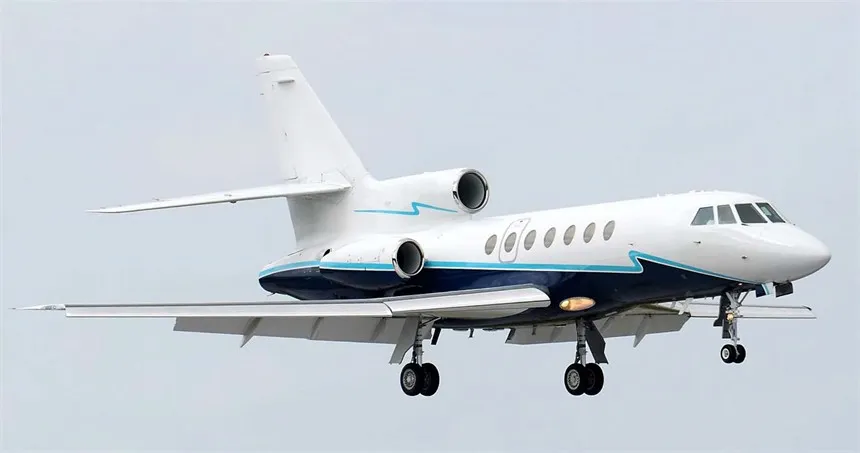
N386TL Aircraft Overview
Performance Profile
N386TL is powered by 3x Honeywell TFE731-3, each producing 3,700 lbs each. The Dassault Falcon 50 cruises at 481 knots with a range of 3,000 nautical miles under standard reserves. This covers most transcontinental routes without a fuel stop.
Mission Profile
The Dassault Falcon 50 seats up to 10 passengers in a cabin measuring 23.5 ft long, 6.1 ft wide, and 5.9 ft tall. N386TL operates in the heavy jet segment where cabin volume supports full-day productivity on coast-to-coast flights.
Charter Authorization
Charter authorization is active for N386TL under its Part 135 certificate. The Dassault Falcon 50 is positioned for domestic transcontinental and Caribbean routing. Contact The Jet Finder to check scheduling.
Insider Note
The Dassault Falcon 50 fleet includes a wide range of configurations and avionics suites across production years. N386TL's 1990 vintage places it in a specific generation of the platform. Buyers comparing airframes should focus on avionics upgrade status, interior refurbishment date, and engine program enrollment rather than total airframe hours alone.
Charter & Acquisition Briefing
N386TL, a 1990 Falcon under , carries French military engineering heritage dating back to Dassault's Mystere fighter program. Below is the operational context.
Fleet Position
Over 1,200 early Falcons (10, 20, 50) were produced. Approximately 200 remain on active U.S. registrations. FAA data shows N386TL based in —, . The Falcon 50 remains valued for its tri-engine configuration and short-field capability. Parts support continues through Dassault Falcon Jet's U.S. service network.
Charter Availability
N386TL is Part 135 charter authorized. Early Falcon charter rates range from $4,000 to $7,000 per flight hour depending on variant. The Falcon 50's tri-engine safety record and European airport accessibility make it a niche charter choice for passengers who value the Dassault brand.
Market Position
N386TL is a 1990 Falcon 50 from the late production run. Pre-owned values range from $1M to $3M. The late Falcon 50 benefits from the most refined version of the tri-engine design, with improved TFE731-40 engines and updated Collins avionics.
The Falcon 50 occupies a unique position: three engines provide safety margins for overwater operations, and the leading-edge slats allow approach speeds 20 knots slower than competing twin-engine jets. For operators who fly regularly to the Caribbean, Bahamas, or across the Atlantic, the tri-engine configuration is a genuine safety differentiator.
Mission Profile
Optimized for European and overwater operations where short-field access and engine redundancy matter. The Falcon 50 lands at London City, Cannes-Mandelieu, and hundreds of Mediterranean airports that competing jets cannot access. The tri-engine design provides continued powered flight after any single engine failure.
When to Choose Something Else
Skip the early Falcon for domestic U.S. operations without short-field requirements. The tri-engine maintenance cost on the Falcon 50 ($200,000+ annually more than a twin) is unjustified if you never use challenging airports. For standard runway operations, a Challenger or Gulfstream is more economical.
Ownership & Operations
Aircraft ownership in the United States falls under FAA registration requirements. Every U.S.-registered aircraft carries an N-number that links to public records including owner name, address, airworthiness date, and certificate type. The FAA Aircraft Registry maintains this data and updates it as aircraft change hands. Prospective buyers use these records to verify ownership history, lien status, and maintenance compliance before committing to an acquisition.
Pre-Purchase Considerations
Avionics modernization drives both capability and market value. Aircraft with legacy analog instruments trade at significant discounts to those with modern glass cockpits (Garmin G5000, Collins Pro Line Fusion, Honeywell Primus Epic). ADS-B Out compliance is now mandatory in U.S. controlled airspace. Buyers should factor avionics upgrade costs into their acquisition budget when evaluating older airframes.
Charter Market Context
Empty leg pricing offers 25 to 75% discounts on published charter rates. These opportunities arise when an aircraft needs to reposition from a drop-off point back to base or to the next pickup location. The tradeoff is schedule inflexibility: departure time, date, and route are fixed by the operator's existing itinerary. The Jet Finder maintains an empty leg alert system for frequent charter clients.
N386TL Aircraft Intelligence
Cross-referenced from FAA Registry, Part 135 operator database, and live ADS-B telemetry.
Inquire About N386TL
Contact us to see if this aircraft is available for a charter flight or acquisition that fits your needs. If the aircraft is not available or does not work for you, we operate private aircraft as well and have access to more than 15,000 private aircraft worldwide.
For more information contact us and one of our private aviation advisers will be happy to assist you.
Contact UsDetailed Specifications
Aircraft Identity
| Registration | N386TL |
|---|---|
| Manufacturer | Dassault |
| Model | Dassault Falcon 50 (Falcon 50) |
| Category | Super Midsize |
| Cabin Class | — |
| Year Built | 1990 |
| Home Airport | KFXE |
| Interior Refurbished | 1/1/2019 |
| Exterior Refurbished | 9/1/2019 |
Performance & Capabilities
| Engine Type | 3x Honeywell TFE731-3 |
|---|---|
| Engine Thrust | 3,700 lbs each |
| Max Cruise Speed | 481 knots |
| Maximum Range | 3000 nautical miles |
| Service Ceiling | 49000 feet |
| Takeoff Distance | 4,700 ft |
| Passenger Capacity | — |
| Baggage Volume | 115 cu ft |
| Avionics | Collins Pro Line/Honeywell |
| IFR Certified | Yes |
Frequently Asked Questions About N386TL
16 questions answered about this aircraft and the Dassault Falcon 50
N386TL is a 1990 Dassault Falcon 50 (Falcon 50) registered in the United States. It carries serial number on file with the FAA and is classified as a heavy jet in the private aviation market. The aircraft has maintained continuous airworthiness for 19 years.
N386TL is a Dassault Falcon 50 (Falcon 50). The Dassault Falcon 50 is a heavy jet platform with a range of 3,230 nautical miles. Dassault has a well-established support network for this airframe.
The Dassault Falcon 50 is powered by 3x Honeywell TFE731-3, each producing 3,700 lbs each. Engine maintenance programs from the manufacturer spread overhaul costs across flight hours, making operating expenses predictable. The powerplant supports a service ceiling of 49,000 feet.
The Dassault Falcon 50 has a maximum cruise speed of 481 knots. Long-range cruise is 430 kts. At these speeds, a three-hour flight covers approximately 1443 nautical miles, connecting most major city pairs within its range envelope.
The Dassault Falcon 50 (Falcon 50) has an approximate range of 3,000 nautical miles. This translates to nonstop coverage of transatlantic routes including New York to London, or Los Angeles to Honolulu. At a cruise speed of approximately 481 knots, total block times remain competitive for the category.
The Dassault Falcon 50 seats up to 10 passengers in a typical charter configuration. The cabin measures 23.5 ft long, 6.1 ft wide, and 5.9 ft tall. Standard configurations include forward club seating, a mid-cabin conference group, and an aft divan.
The Dassault Falcon 50 has a maximum service ceiling of 49,000 feet (FL490). At this altitude, the aircraft operates above commercial traffic and most weather systems. The pressurization system maintains a cabin altitude of approximately 4,500-5,500 feet at maximum cruise altitude, reducing passenger fatigue on long flights.
Yes. The Dassault Falcon 50 is fully certified for IFR (Instrument Flight Rules) operations. It is equipped with Collins Pro Line/Honeywell avionics avionics, supporting precision approaches, RNAV/GPS navigation, FANS/CPDLC for oceanic operations, and ADS-B Out compliance. All Part 135 charter operations require two instrument-rated pilots.
The Dassault Falcon 50 cabin measures 23.5 ft long, 6.1 ft wide, and 5.9 ft tall. Most passengers can stand upright in the center aisle. Baggage capacity is 115 cu ft.
The Dassault Falcon 50 has 115 cu ft of baggage volume in an externally accessible, heated and pressurized compartment. This accommodates 10+ full-size suitcases or a combination of luggage, garment bags, and sporting equipment. The compartment does not intrude on cabin space.
The Dassault Falcon 50 is equipped with Collins Pro Line/Honeywell avionics. This integrated flight deck provides enhanced situational awareness, synthetic vision, TCAS II, and weather radar. The system supports single-crew operations where type-certified, though Part 135 charter flights require two pilots.
The Dassault Falcon 50 was produced from 1979-2008. The type was succeeded by the Falcon 900. This specific aircraft (N386TL) was manufactured in 1990.
The Dassault Falcon 50 competes in the Heavy Jet segment against aircraft with similar range and cabin specifications. Key differentiators include a cruise speed of 481 knots, range of 3,000 nm, and a 6.1 ft-foot-wide cabin. Selection between competing types depends on mission profile, operator availability, and total trip cost.
Charter rates for the Dassault Falcon 50 typically range from $3,500-$4,800 per flight hour, depending on operator, region, and seasonal demand. This includes crew, fuel at current Jet-A prices, and standard handling. Additional costs may include FBO fees, overnight crew expenses, international handling, and repositioning if the aircraft is not based at the departure airport.
Contact The Jet Finder to inquire about charter availability for N386TL. We have access to more than 15,000 private aircraft worldwide.
Contact us for acquisition information about N386TL. Our aviation advisors can provide market valuation and availability details.
From Your First Mission to Your Final Acquisition
Contact us to see if this aircraft is available for a charter flight or acquisition. If this aircraft is not available, we operate private aircraft and have access to more than 15,000 private aircraft worldwide.